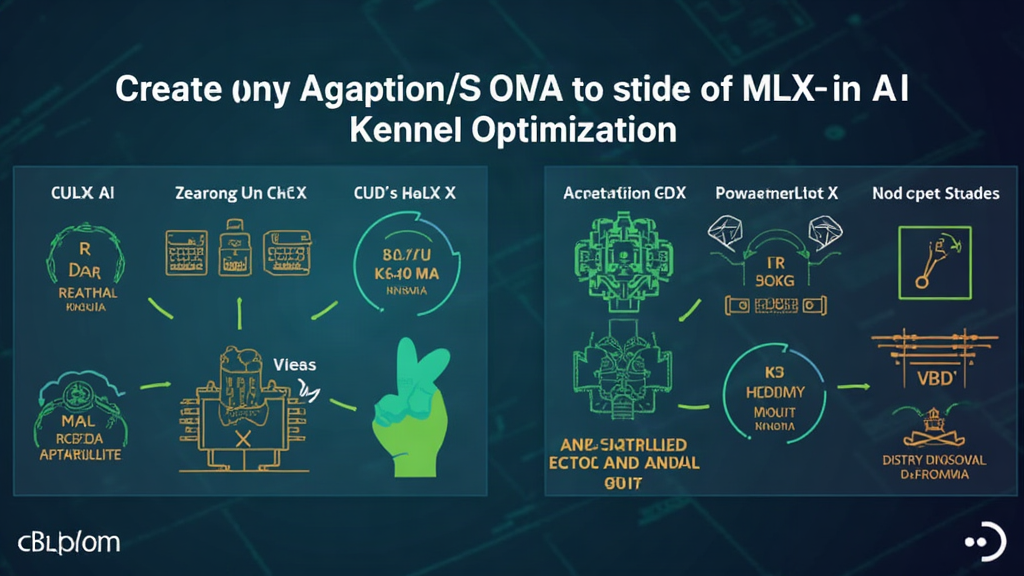
In the realm of modern computing, K-Search expertise stands at the forefront of revolutionizing the efficiency of GPU kernels, particularly within Apple’s Silicon architecture. As hardware evolves rapidly, understanding how to bridge legacy CUDA optimizations with the new MLX framework is paramount for achieving peak performance. K-Search serves as a pivotal platform, leveraging AI-driven methodologies to seamlessly translate the extensive knowledge gained from years of kernel optimization. By focusing on GPU kernel efficiency, this innovative approach not only enhances the Apple Silicon performance but also addresses the intricate challenges associated with kernel adaptation across different architectures. As AI workloads dominate, K-Search expertise becomes essential for any developer looking to maximize their application’s computational capabilities.
K-Search expertise embodies a cutting-edge approach to kernel optimization, particularly relevant in the context of machine learning frameworks like MLX. In this fast-paced technological landscape, knowledge transfer from CUDA to MLX has become a critical focus for developers aiming to leverage the full potential of Apple silicone chips. The concept of AI kernel search enables a sophisticated optimization process that enhances computation efficiency in various applications. Leveraging advancements in Apple’s MLX framework, this methodology not only cultivates superior performance outcomes but also redefines how developers approach the complexities of multi-vendor architecture optimization. Ultimately, the synergy of K-Search and emerging technologies represents a significant leap towards a more efficient AI-driven future.
K-Search Expertise in Kernel Optimization
K-Search stands as a pioneering framework in the realm of kernel optimization, effectively leveraging decades of expertise accumulated through CUDA programming. The core advantage of K-Search lies in its evolutionary approach, where the optimization of GPU kernels is handled in an iterative manner. This iterative loop not only evaluates existing kernels but also generates new candidate solutions tailored to specific architectures, such as Apple Silicon. This translates complex CUDA operations into efficient MLX implementations without merely replicating code, enhancing kernel performance while preserving the inherent logic of advanced algorithms.
The adaptability of K-Search allows it to transcend the limitations imposed by specific hardware architectures. By utilizing a specialized knowledge transfer mechanism between CUDA and MLX, K-Search can autonomously identify and apply relevant optimizations to existing kernels. For instance, it intelligently reformulates memory management strategies and computational patterns, ensuring that critical operations are efficiently executed. The framework demonstrates remarkable potential in maintaining high performance on varied chip architectures, further solidifying K-Search’s reputation as a formidable tool for AI kernel search.
The Transition from CUDA to MLX: Challenges and Solutions
Transitioning from CUDA to MLX presents unique challenges, particularly due to the differences in architectural principles and performance characteristics between NVIDIA’s GPUs and Apple Silicon. One of the primary hurdles is the direct mapping of CUDA constructs to their MLX counterparts, which often requires a nuanced understanding of the underlying hardware. The transformation process necessitates more than simple code translation; it demands a deep contextual adaptation to align with Apple’s Metal APIs while optimizing resource utilization effectively.
To address these challenges, K-Search employs a structured translation layer that includes concept mapping tables and optimization patterns specifically designed for MLX. This setup allows for the effective preservation of performance characteristics originally designed for CUDA while adapting them to fit the new architecture. In essence, K-Search transforms what could be a laborious and error-prone manual process into a rapid, automated optimization journey, significantly reducing the time and expertise required to achieve high-performance kernels on Apple Silicon.
Frequently Asked Questions
What is K-Search and how does it optimize GPU kernels for Apple Silicon using MLX?
K-Search is an advanced evolutionary kernel optimization framework developed to enhance GPU kernel performance, specifically for Apple Silicon using the MLX framework. By leveraging decades of expertise from CUDA optimizations, K-Search employs a systematic search strategy to iterate over potential kernel configurations. It generates and benchmarks kernels against real hardware, optimizing them according to hardware constraints and optimization patterns unique to Apple’s MLX. This results in kernels that are fine-tuned for performance on Apple devices, achieving significant speedups while ensuring efficient execution.
| Key Point | Description |
|---|---|
| Rapid Hardware Development | The computing landscape is evolving quickly with new AI-tailored hardware architectures from various vendors. |
| Importance of GPU Kernels | Efficient GPU kernels are critical for the success of AI applications, requiring years of expertise to develop. |
| K-Search Framework | K-Search uses an evolutionary approach to optimize GPU kernels, enabling automatic adaptation of CUDA kernels for Apple Silicon (MLX). |
| Performance Gains | The optimized kernels achieve near-expert performance on Apple Silicon, with significant speedups over traditional implementations. |
| Translation Layer | A novel translation layer enables the transfer of optimization knowledge from CUDA to MLX, facilitating better performance without starting from scratch. |
Summary
K-Search expertise is revolutionizing the optimization of GPU kernels, especially for Apple Silicon. By leveraging a structured translation layer, the K-Search framework allows developers to transfer decades of CUDA kernel optimization knowledge into Apple’s MLX ecosystem. This process not only significantly speeds up the adaptation of existing kernels but also enhances performance dramatically. The continuous advancement of hardware and software demands that developers find innovative solutions like K-Search to bridge the gap between different architectures, thus contributing to the overall improvement in AI performance and efficiency.