
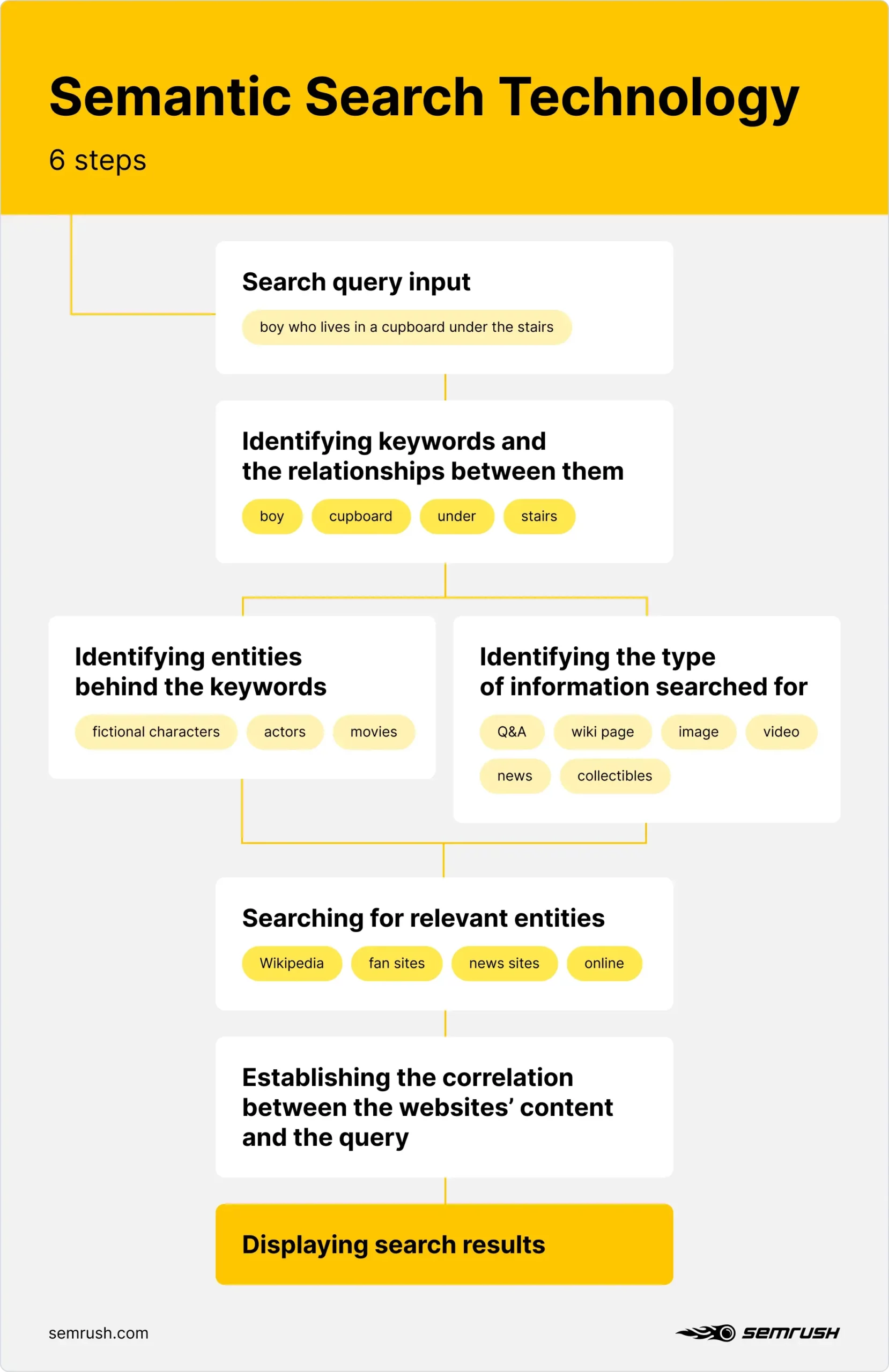
**Semantic search** is revolutionizing the way we interact with information by shifting the focus from mere keyword matching to understanding the meaning behind queries. Unlike traditional search engines that rely solely on keywords, semantic search engines leverage advanced techniques such as context vectors to capture the nuances of language. Incorporating elements of machine learning and deep learning, these systems analyze vast amounts of data to deliver highly relevant results, even when queries are vague or ambiguous. Document clustering plays a critical role in this process, grouping similar documents for improved retrieval efficiency. As we delve into the mechanics of semantic search, we unlock a more intuitive pathway to information discovery, one that aligns closely with how humans naturally seek knowledge.
At its core, semantics refers to the meaning conveyed in language, and semantic searching references an intelligent approach to retrieving information based on this meaning. By utilizing context vectors, these advanced search systems can interpret and align user queries with relevant documents, accommodating variations in phrasing and intent. This paradigm shift is enhanced by machine learning models that autonomously improve through exposure to data over time, often resulting in superior outcomes compared to basic keyword systems. Furthermore, document classification and clustering methodologies enrich semantic search by organizing vast databases into coherent groupings. This foundational framework is essential for creating search engines that not only understand but anticipate user needs.
Understanding Semantic Search Engines
Semantic search engines leverage advanced computational techniques to enhance the way users retrieve information. Unlike traditional keyword-based systems that rely purely on matching exact terms, semantic search enables a more nuanced understanding of user intent. By utilizing context vectors, the engine can interpret the meaning behind queries and documents alike, allowing for more accurate results. This technology is particularly relevant in fields such as information retrieval and natural language processing, where the subtleties of language and context play a critical role.
The underlying mechanics involve transforming both queries and documents into context vectors, which serve as numerical representations of their meanings. These vectors are then compared using various similarity measures, such as cosine similarity, to identify the closest matches. By employing machine learning techniques, including deep learning models like BERT, developers can build highly effective semantic search engines. This ultimately leads to improved user experience as users can find relevant documents even when they do not know the exact keywords.
The Role of Context Vectors in Document Clustering
Context vectors are crucial in the realm of document clustering, which involves grouping similar documents based on their content. By representing documents as vectors within a multi-dimensional space, clustering algorithms such as K-means can efficiently categorize documents into clusters that share common themes or topics. This method not only enhances organization and retrieval processes but also assists in identifying relationships and patterns within large collections of texts.
With the advancement of machine learning, particularly in deep learning techniques, the accuracy of context vectors has significantly improved. Techniques such as mean pooling help refine these vectors to ensure they effectively capture the essence of a document’s content. Consequently, document clustering becomes a powerful tool for managing vast information repositories, enabling users to discover related documents more rapidly and intuitively. The application of these techniques is particularly beneficial in fields such as academic research and content management, where navigating through extensive databases is a common challenge.
Leveraging Machine Learning for Document Classification
Document classification is another vital application wherein machine learning and context vectors intersect. This process involves assigning predefined categories to documents based on their content, which can be achieved through various supervised learning techniques. By training models on labeled datasets, systems can learn to recognize patterns and features within the context vectors that correlate with specific categories. This results in an automated classification system that can quickly and accurately sort through large volumes of data.
Deep learning models, especially those utilizing advanced natural language processing techniques, excel in this domain. They can capture intricate features that simpler models may overlook, leading to higher levels of accuracy in classification tasks. Furthermore, integrating document clustering with classification can provide a dual-layer approach, where documents are first grouped based on similarity and then classified within those clusters. This strategy enhances the organization and retrieval of documents, making it easier for users to navigate extensive databases.
Integrating Deep Learning in Semantic Search
Deep learning plays a transformative role in enhancing the capabilities of semantic search engines. Utilizing architectures such as transformers, which allow for a better understanding of context and semantics within language, improves how search engines interpret user queries and document relevance. The ability to handle complex language structures means that even vague or ambiguous queries can produce accurate and meaningful results.
Moreover, with the emergence of pre-trained models, developers can integrate powerful deep learning capabilities without the need for extensive datasets. Models like BERT, which provide a distinct advantage in natural language understanding, can be fine-tuned for specific applications in semantic search. This integration not only boosts the relevance of search results but also significantly elevates the overall user experience, as users benefit from more intelligent and responsive search mechanisms.
Combining Context Vectors with Machine Learning
The combination of context vectors and machine learning has revolutionized how we understand and process information. By representing documents as vectors in a high-dimensional space, machine learning algorithms can be trained to identify patterns and classify documents effectively. This synergy allows for applications like clustering and classification to become more sophisticated, as the underlying semantic meanings are preserved and utilized within machine learning models.
As these technologies evolve, the use of context vectors in conjunction with machine learning will lead to even more advanced capabilities in document analysis and retrieval. Systems will not only be able to cluster and classify documents but also generate insights that were previously unattainable. This opens the door for innovative applications across various sectors, including research, business intelligence, and data mining.
Enhancing Document Retrieval with Semantic Search
Enhancing document retrieval through semantic search techniques involves a deep understanding of how users interact with information. The traditional approaches, which rely heavily on exact keyword matches, often fall short in delivering relevant results when user queries are vague or incorrectly phrased. Semantic search addresses this issue by interpreting the intent behind queries using complex context vectors, thereby allowing for a more intuitive retrieval system.
By analyzing the semantic meaning rather than just keywords, semantic search engines can bring forth documents that are contextually related, thereby improving the overall effectiveness of retrieval systems. This is particularly crucial in environments where quick access to accurate information is critical, such as in legal or academic fields. The ability to retrieve documents based on meaning enhances user satisfaction and supports efficient decision-making processes.
The Future of Document Clustering with Machine Learning
The future of document clustering is poised for significant advancements, largely driven by developments in machine learning and artificial intelligence. As algorithms become more refined and capable of understanding the subtleties of human language, the clustering of documents will become not only more accurate but also more aligned with the user’s needs and expectations. This evolution will enable systems to dynamically adjust clusters based on changing data, enhancing the relevance and organization of information.
In addition, the merging of clustering techniques with emerging technologies such as natural language processing and deep learning will create systems that are proficient at adapting to varied user contexts. By continuously learning from user interactions and feedback, these systems will provide increasingly personalized document organization solutions. This targeted approach can significantly improve user workflows, especially in environments with large archives of documents, where effective navigation is essential.
Transforming Information Retrieval with Contextual Understanding
Transforming information retrieval through contextual understanding addresses the limitations of conventional search systems that often fail to grasp the nuance of user queries. By incorporating semantic search technologies, systems can now obtain a clearer picture of user intent, leading to more relevant result outputs. This contextual approach helps in bridging the gap between user inputs and the vast ocean of documents available, creating a more efficient and effective search experience.
Further advancing this transformation is the application of deep learning and machine learning algorithms that continually refine their understanding of context vectors. As these technologies become even more intelligent, their ability to accurately predict user needs and adjust search outputs accordingly will only improve. This progression will not only enhance retrieval accuracy but also facilitate a more satisfying interaction between users and information systems.
Optimizing Document Analysis through Machine Learning Techniques
Optimizing document analysis through machine learning involves leveraging algorithms that can dissect and understand vast amounts of text data quickly. As organizations generate and accumulate more information, the need for effective analysis tools becomes critical. Machine learning models provide capabilities to analyze documents at scale, identifying key themes, topics, and trends that may not be immediately visible to human analysts.
By employing advanced techniques such as clustering, classification, and semantic search, businesses can gain valuable insights from their document repositories. The integration of these technologies will enable organizations to streamline their data processes, minimizing the time spent on manual analysis. As machine learning continues to evolve, document analysis will become increasingly automated, freeing up human resources for more strategic tasks.
Frequently Asked Questions
What is semantic search and how does it improve search results?
Semantic search enhances search engine functionality by allowing queries to be understood based on their meaning rather than just keyword matching. By utilizing context vectors that represent the meanings of documents, semantic search identifies more relevant results, thus increasing accuracy in search outcomes.
How do context vectors play a role in semantic search engines?
Context vectors are numerical representations of documents that capture their semantic meaning. In a semantic search engine, these vectors enable the engine to assess the similarity between the user’s query and documents, leading to improved search results that reflect the user’s intent.
Can document clustering techniques be integrated with semantic search?
Yes, document clustering can be effectively integrated with semantic search. By using context vectors to group similar documents, a semantic search engine can facilitate better organization, helping users find related content more easily.
How do machine learning and deep learning contribute to semantic search development?
Machine learning and deep learning are pivotal in developing semantic search capabilities. Machine learning algorithms train models to understand patterns and relationships in data, while deep learning enhances the processing of natural language by leveraging neural networks, improving the accuracy and effectiveness of semantic searches.
What are the benefits of using deep learning in semantic search applications?
Deep learning significantly benefits semantic search applications by enabling the processing of complex data structures and semantics. It allows for better feature extraction and understanding of context, leading to more accurate search results by interpreting the nuances in user queries.
How can I build a semantic search engine using context vectors?
To build a semantic search engine, you can use libraries like Hugging Face Transformers to generate context vectors from documents and queries. By calculating similarities between these vectors, you can effectively retrieve documents that best match the user’s intent.
What techniques are used for document classification in semantic search?
Document classification in semantic search often employs machine learning algorithms alongside context vectors. These vectors help the classification models accurately categorize documents based on their semantic content, enhancing the efficiency of information retrieval.
What is the significance of cosine similarity in semantic search?
Cosine similarity is a metric that measures the cosine of the angle between two non-zero vectors, such as context vectors in semantic search. It is significant because it quantifies the similarity in meaning between a query and documents, allowing for more accurate search results.
| Topic | Key Points |
|---|---|
| Building a Semantic Search Engine | Utilizes context vectors to enhance searching accuracy beyond keyword matching, improving document retrieval by understanding query meaning. |
| Document Clustering | Groups similar documents using context vectors, making it easier to manage and navigate large datasets. |
| Document Classification | Assigns documents to predefined categories based on their context vectors, automating the organization of information. |
Summary
Semantic search plays a crucial role in enhancing information retrieval by focusing on the meaning of words rather than mere keyword matches. This methodology, alongside techniques like document clustering and classification using context vectors, allows for a more nuanced understanding of textual data. As organizations seek efficient ways to manage and retrieve information, implementing semantic search engines proves to be indispensable for improving user experiences and operational efficiencies.